In our recent posts, we talked about small ways to support the nervous system: breathing, movement, sound, rest, and noticing when the body may need a little more support.

A common thread runs through all of those practices.
The body is communicating.
Sometimes it communicates through shallow breathing, tight shoulders, a clenched jaw, restlessness, fatigue, discomfort, or the sense that we are moving through the day without feeling fully present.
Listening to the body can be a meaningful part of whole-person wellness. But listening is not always easy, especially when the body feels depleted, tense, overwhelmed, or disconnected.
Mind-body awareness does not happen in isolation. It is shaped by how we are sleeping, moving, resting, breathing, eating, recovering, and physically feeling throughout the day.
In other words, it can be easier to listen to the body when the body feels supported.
The body gives information
Body awareness is not about interpreting every sensation perfectly. It is not about monitoring yourself all day or turning wellness into another assignment.
It is simply the practice of noticing.
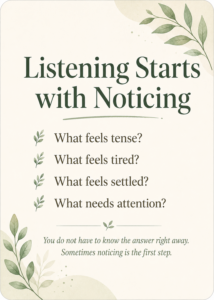
What feels tense?
What feels tired?
What feels settled?
What feels braced?
What feels like it needs attention?
Sometimes the answer is clear. Sometimes it is not. The goal is not to force an answer, but to create enough space to notice what is happening without immediately dismissing, judging, or overriding it.
Support can take many forms
For some people, physical support may look like rest, stretching, hydration, walking, therapy, medical care, nourishing food, or a more consistent wind-down routine.
For others, support may begin with something very small: unclenching the jaw, lowering the shoulders, taking a breath before responding, or pausing between one activity and the next.
Support does not have to be dramatic to matter.
Sometimes a small shift helps the body feel just safe enough to be noticed. And being noticed is often where care begins.
Listening is not the same as forcing
One thing we want to be careful about is the idea that wellness means making the body respond in a specific way.
That is not the goal.
The goal is not to force calm, force relaxation, or force the body into stillness. The goal is to build a more compassionate relationship with the body over time.
That might mean noticing when the body needs movement or rest.
It might mean recognizing tension earlier, before it becomes overwhelming.
Over time, it may also mean learning which supports help you feel more grounded, present, or connected.
The question is not, “Am I doing this correctly?”
A more helpful question could be, “What do I notice?”
Once we notice what the body is telling us, we can begin asking, “What do I need?”
And sometimes, especially when we are overwhelmed, that question may be hard to answer. That is okay. Sometimes noticing is the first step. Awareness can create space for clarity, care, and support to emerge over time.
Whole-person wellness starts with listening
The body is not a problem to solve.
It is a source of information.
When we slow down enough to listen, we may begin to notice what helps us feel more supported, more connected, and more present in our own lives.
In a related post, we’ll share more about one of the wellness technology tools available in our office: BEMER, a device designed to support circulation as part of a broader whole-person wellness routine.